The science tech tree is far bigger and more branched than we realize. Most of it will never be explored. An alien civilization's technology stack would likely be radically different from ours, shaped by different senses and environments.
There is a popular picture of science as a single linear "tech tree." First electricity. Then computers. Then AI. As if every advanced civilization eventually walks the same path in roughly the same order.
However, this picture can be too narrow.
The actual tech tree is enormous and densely branched. The path we take is highly contingent on our environment and sensory biases. In other words, scientific progress can be path-dependent and far from inevitable.
For example, the foundations of computer science were laid in the 1930s. But almost a century later, we are still discovering profound and foundational ideas inside those foundations, such as public-key cryptography, decentralized ledgers, and quantum computing. One small branch keeps unfolding into more branches.
Therefore, an alien civilization might have a completely different tech stack. Perhaps they master biology or complex systems long before discovering radio.
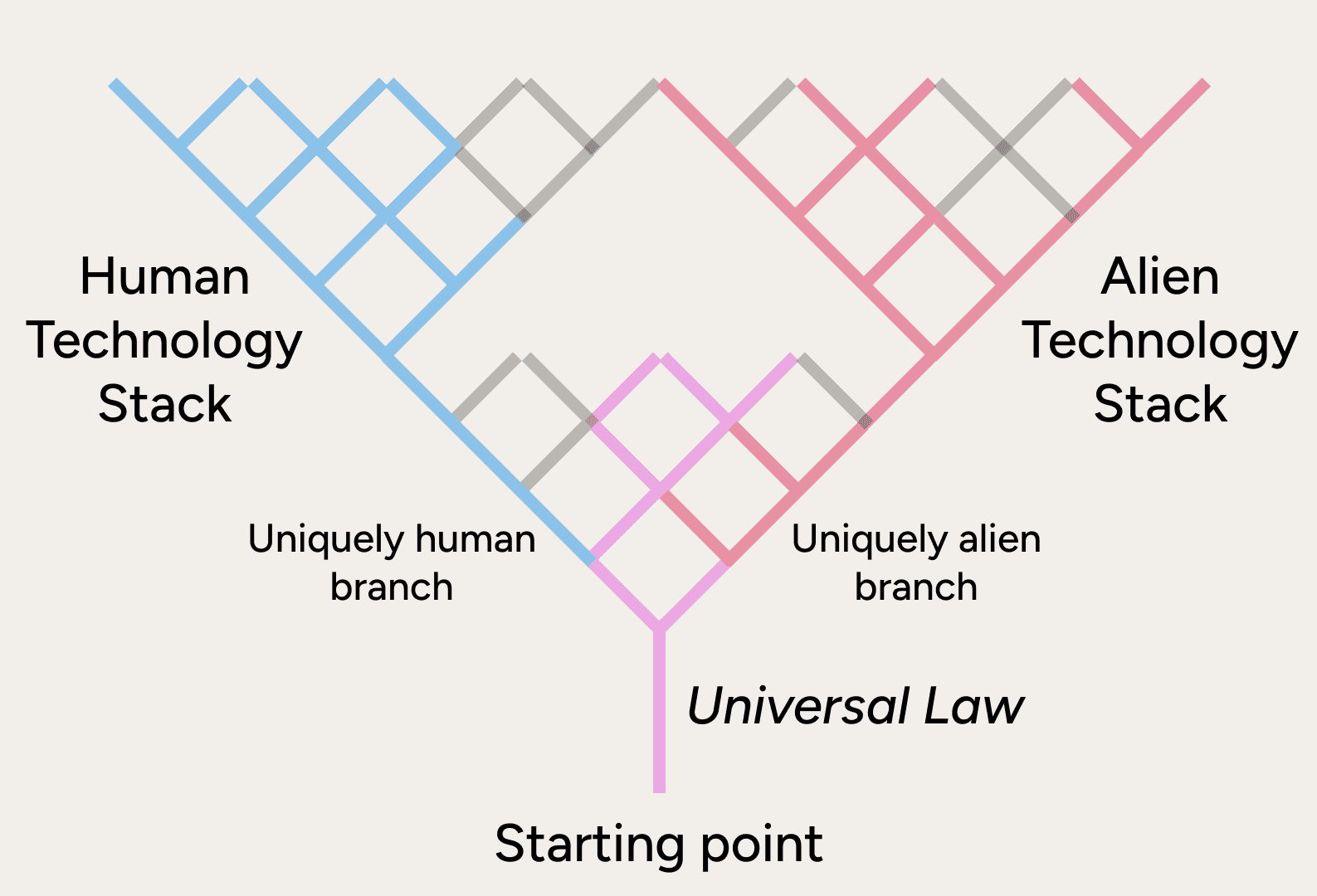
If this assumption is true, the corollary is that we have significant agency over the future. Because most of the tech tree will never be explored, we aren't actually following a map. Instead, we are choosing which branches to grow and which ones to cut off.
This optimistic view on human agency feels close to Definite Optimism.