Cognitive Load Theory: Learning fails when working memory is overloaded. Design should protect mental bandwidth.
Article: Cognitive Load Theory
Cognitive Load Theory (CLT) is one of the most well-known frameworks that explains how the brain processes and retains information by managing the limitations of working memory.
It starts from a simple constraint: working memory is limited. If we exceed it, learning slows or stops.
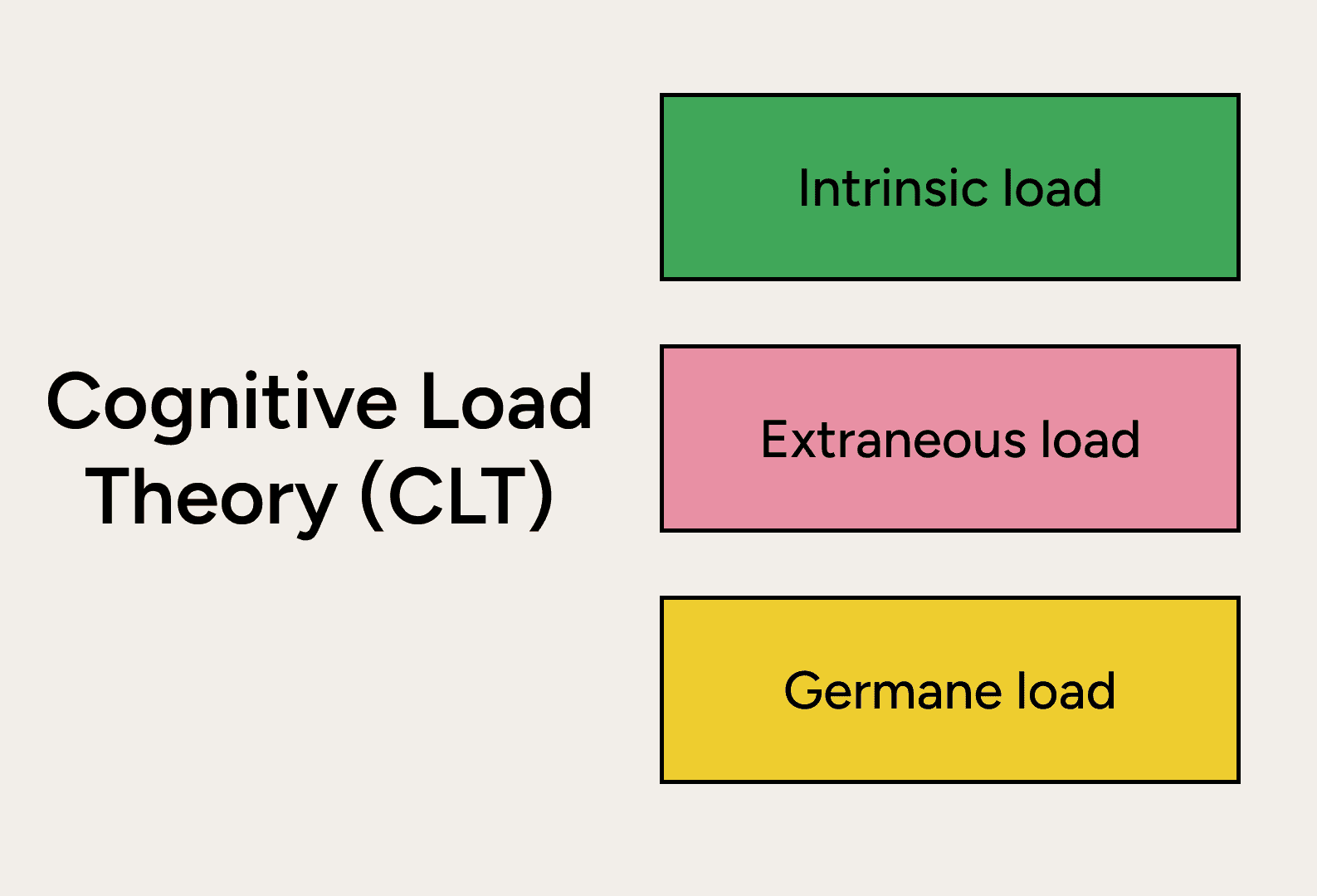
CLT breaks mental effort into three cognitive loads:
- Intrinsic load: How easy or difficult the content presented inherently is to learn, which stays relatively constant.
- Extraneous load: How easy or difficult it is to learn the content, considering the environment in which it is presented.
- Germane load: How much effort is required to apply memory and the intelligence used to make schemas for permanent storage.
 It's perhaps helpful to think of germane load as the result of managing the other two. For example, we reduce Extraneous load specifically to free up mental bandwidth for Germane load.
Intrinsic load is hard to reduce but can be managed. For example, breaking complex ideas into smaller parts and teaching prerequisites first.
Extraneous load is easier to reduce, but still, poor presentation or distractions are everywhere. We should use clean layouts, remove unnecessary steps, and avoid split attention.
We can also increase germane load. For example, we should use worked examples, reflection, and practice that forces sense-making.