The Drama Triangle: If you cannot face another person directly, you will drag a third person in and call it "process". The three roles of Victim, Persecutor, and Rescuer rotate endlessly and rot companies from the inside.
Have you ever seen someone bring a complaint to a manager instead of talking to the person directly?
In 1968, psychiatrist Stephen Karpman published a model called the Drama Triangle. It describes three roles people unconsciously rotate through: the Victim ("poor me"), the Persecutor ("it's your fault"), and the Rescuer ("let me help you").
The roles are not fixed. They shift constantly. A Rescuer who feels unappreciated flips to Persecutor. A Victim who accumulates enough resentment also becomes the Persecutor. No matter where you start on the triangle, everyone ends up feeling like a victim.
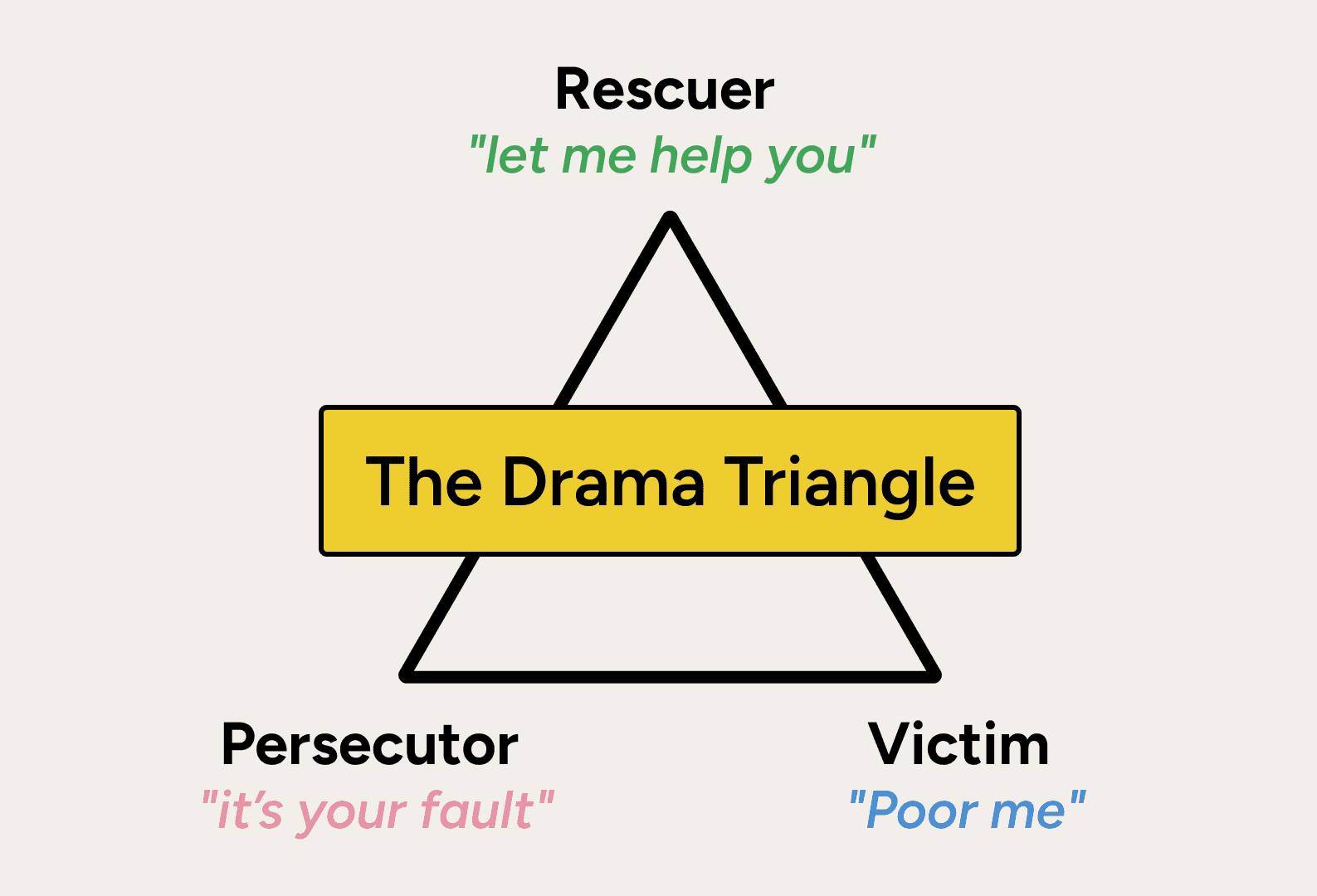 In organizations, this becomes triangulation. Person A has an issue with Person B, so A goes to a manager instead of talking to B directly. The manager now holds anxiety that belongs to A and B.
And the worst part: the triangulation gets legitimized. It becomes "process."
Anonymous feedback tools, mediation protocols, and escalation frameworks absorb the anxiety that two adults could resolve in a 15-minute conversation. Once the process exists, going direct is seen as aggressive. The triangle has eaten the culture.
David Emerald's Empowerment Dynamic offers an easy antidote: speak directly!
Therefore, the Victim becomes a Creator who asks, "What do I want?" The Persecutor becomes a Challenger who holds others accountable with care. And the Rescuer becomes a Coach who asks, "Have you spoken to them about this?"