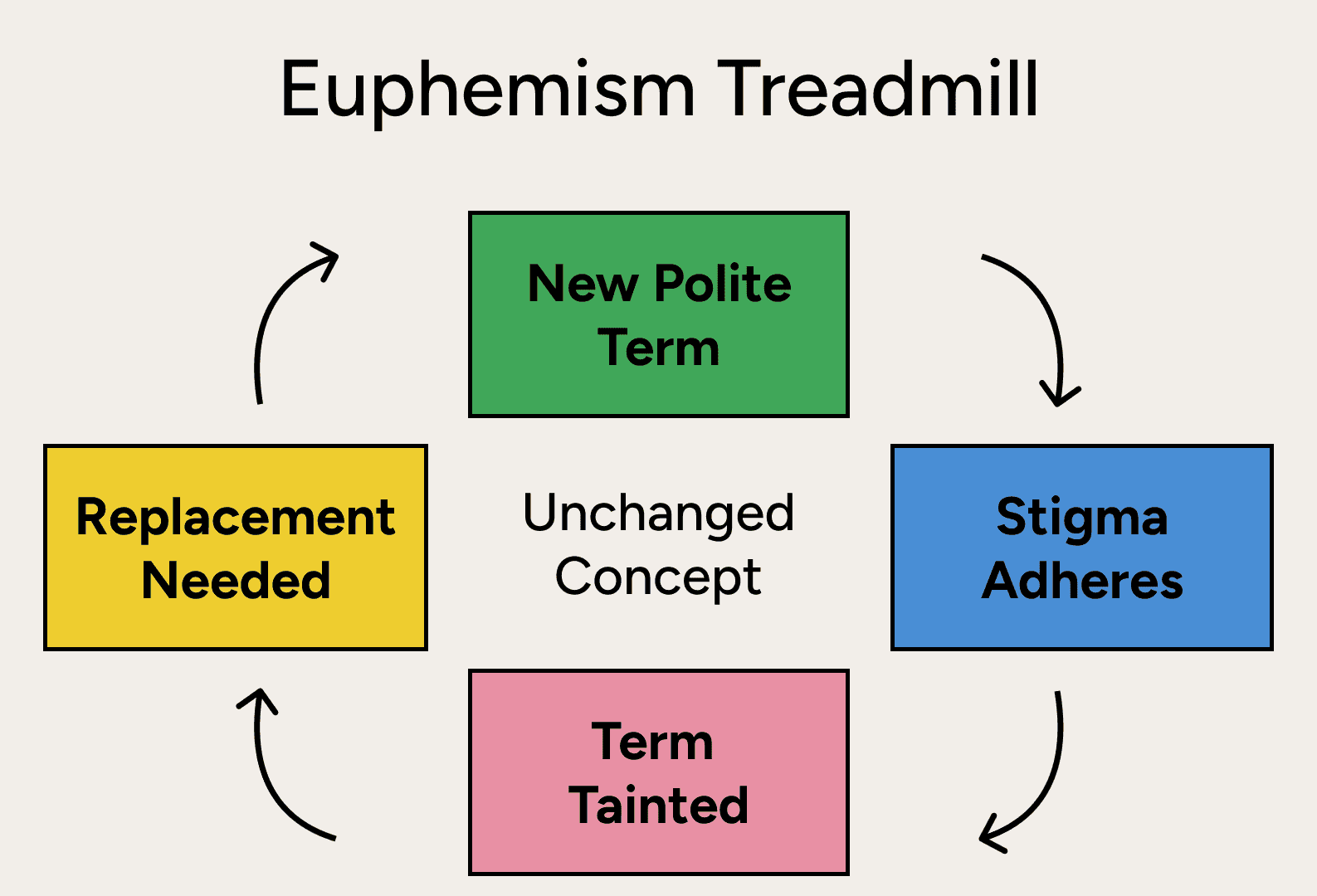
The Euphemism Treadmill: Replacing an offensive word with a neutral one doesn't remove the stigma. Because concepts, not words, drive how people feel, any new term will eventually absorb the same negativity as the one it replaced.
Why do polite words keep becoming impolite?
Steven Pinker popularized a useful idea: the euphemism treadmill. The pattern: we replace an offensive word with a neutral one, but the new word eventually absorbs the same stigma. So we replace it again.
For example, "Imbecile" was replaced by "retarded," which was replaced by "mentally challenged," which was replaced by "intellectually disabled."
Each term starts clean and ends tainted. The underlying condition hasn't changed much. But the label constantly changes.
First, we introduce a cleaner term. Then, social stigma "contaminates" it through repeated use. Eventually, that term feels insulting too. Then we create another term and restart the cycle.
The same happens with "water closet" → "toilet" → "bathroom" → "restroom." The room is the same. We just keep renaming it.
Pinker argues that concepts, not words, are primary in our minds. In his words
"Give a concept a new name, and the name becomes colored by the concept; the concept does not become freshened by the name."
Updating language matters because words can reduce unnecessary harm in the short run. But Pinker's deeper point is still useful: concepts are sticky. If we want better language over the long run, we also need better institutions, better incentives, and better norms.
And again, this is related to our favorite philosopher Wittgenstein's two concepts: Family Resemblance and Language Games.
Also relate: replacing the "R-Word" (though I don't think Steven Pinker actually "coined" the word Euphemism Treadmill)