The Hot-Cold Empathy Gap: When calm, we overestimate how rational we'll be when emotional. When emotional, we assume we'll always feel this way. Both predictions are wrong.
Article: Empathy Gap
Imagine you're asked how you'd respond if someone unconscious needed help. You'd probably say you'd perform CPR. But if you actually found yourself in that situation, fear and anxiety might cause very different behavior.
This gap is the empathy gap, also known as the hot-cold empathy gap.
"Hot" states are emotional states, such as hunger, fear, and anger. "Cold" states are calm and rational.
The empathy gap describes our tendency to underestimate the influence of varying mental states on behavior and make decisions that only satisfy our current state.
Someone decides to quit drinking. A friend invites them to a party. When deciding to go, they're confident in their self-control. At the party, anxiety and temptation hit. They didn't predict this.
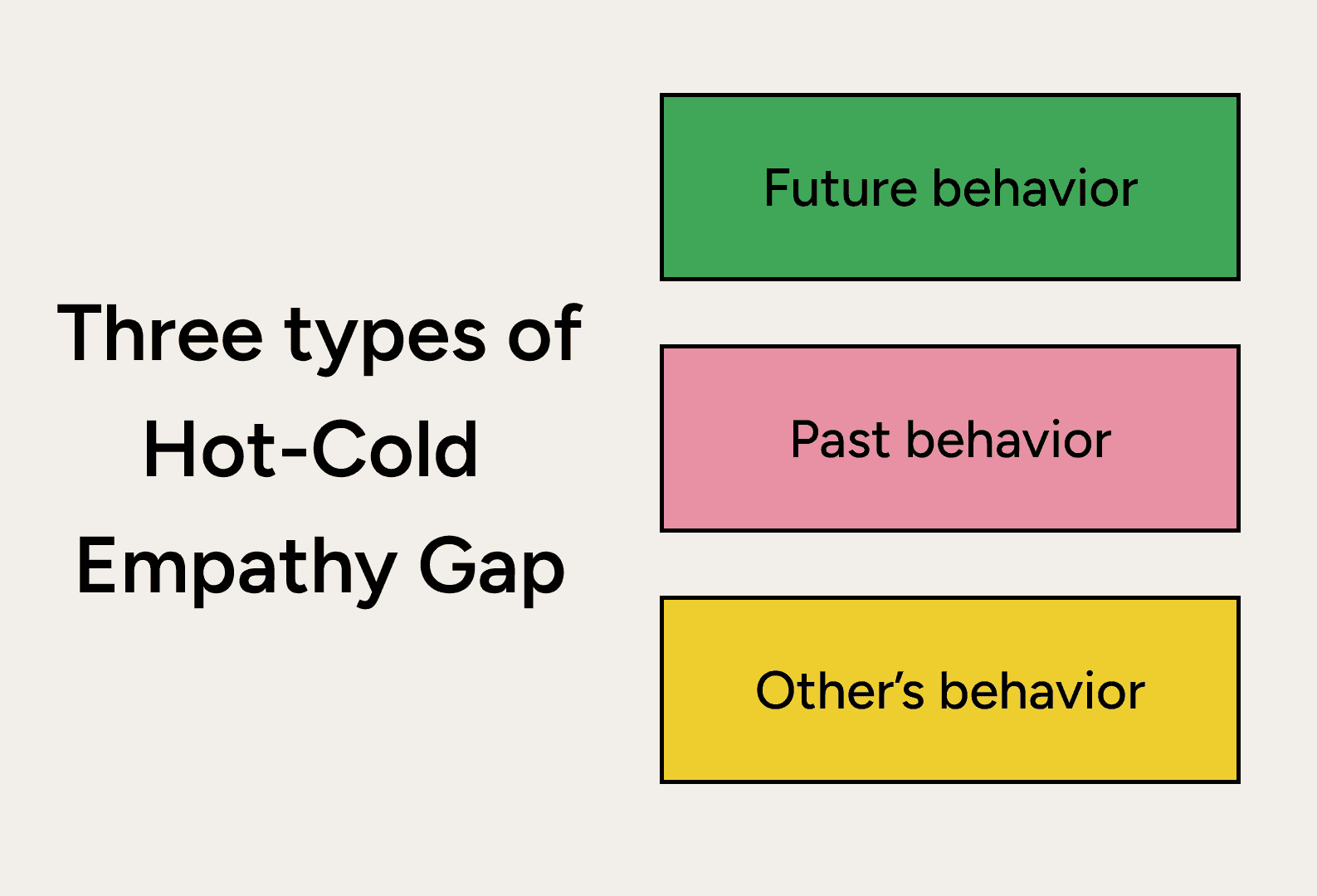
Psychologists identify three types of empathy gaps:
- Intrapersonal Prospective (About Future): We can't predict our future behavior in different emotional states. A smoker who feels relaxed might assume quitting will be easy.
- Intrapersonal Retrospective (About Past): We can't remember why we acted a certain way in the past. After an argument, we can't comprehend why we lost our temper.
- Interpersonal (About Others): We can't understand others in different emotional states. A well-rested person struggles to understand a sleep-deprived parent's exhaustion.
Our Weekly I/O's old friend George Loewenstein tested this in 1999. He asked people how much money it would take to put their hands in ice water. Those experiencing pain right then needed the most money. Those who'd never felt it needed the least.
Our current state anchors our predictions. And the most reliable way to fix it is to use past behavior to predict the future. Visualize different emotional states before deciding.
Before a social event where you're worried, remember: last time you felt this way, how did it actually go?