Zoom in with notes to improve the craft, zoom out with faith to protect the momentum. Be a micro-pessimist to critique the details ruthlessly and a macro-optimist to protect the vision endlessly.
Podcast: 35: Brie Wolfson - Loving Attention & Ease in Craft
Great feedback holds two opposing perspectives simultaneously.
Brie Wolfson, former Head of Editorial at Stripe Press, describes this as being "a micro-pessimist and a macro-optimist." When you zoom in, you should ruthlessly critique the details. Nothing escapes scrutiny.
But when you zoom out, you protect the vision. You keep the creator excited about the work. You remind them why this matters.
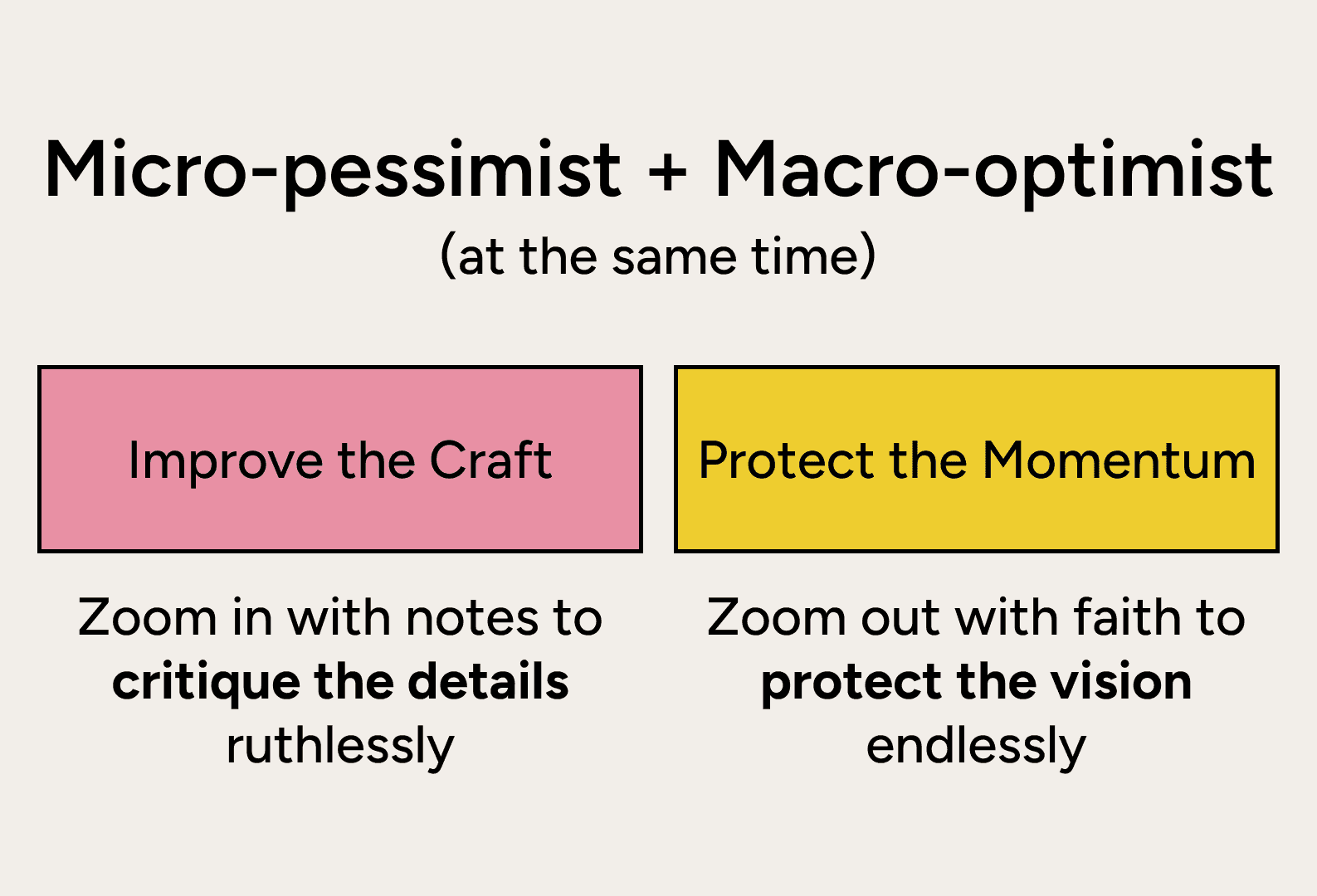
This balance is hard because most people default to one extreme or the other.
Pure pessimists kill projects before they can breathe. Pure optimists let mediocrity ship. The best feedback needs to do both: scrutinize like a critic, believe like a champion.
I find this framework useful beyond giving feedback. When evaluating my own work, I tend to be either too harsh or too generous, depending on my mood. Zooming in with notes and zooming out with faith gives me a structured way to do both.
And when receiving feedback, I remind myself: we should push for harsher feedback while staying macro-optimistic ourselves.
This also connects to two previous inputs on feedback (three feedback questions, four types of feedback) and the two on holding opposing ideas (scientists and ambiguity, Augustine's divided will).