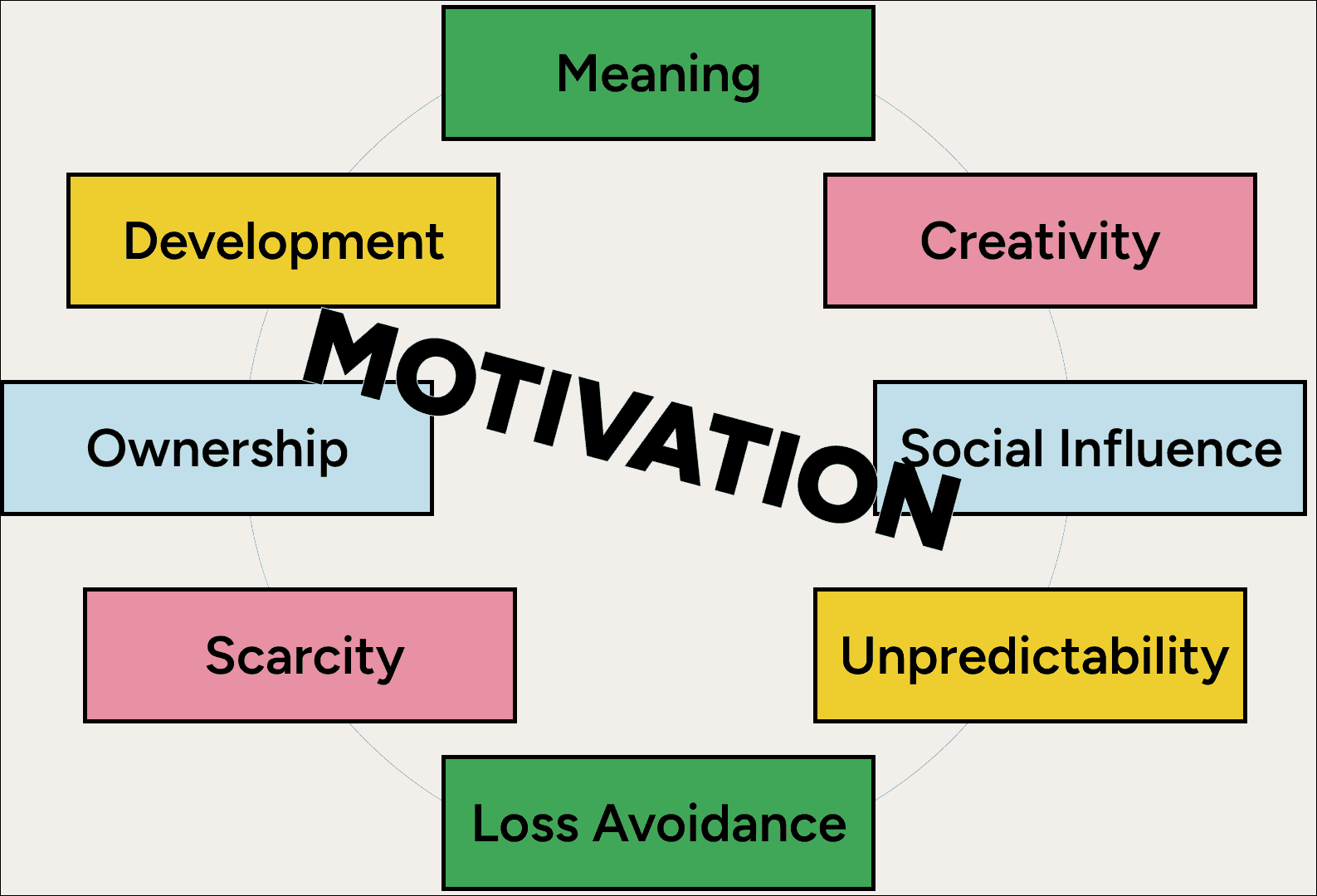
Motivation comes from eight core drives: Meaning, Development, Creativity, Ownership, Social influence, Scarcity, Unpredictability, and Loss Avoidance.
Book: Actionable Gamification: Beyond Points, Badges, and Leaderboards
Octalysis is an interesting human-focused framework for understanding how design motivates people. Instead of asking "what feature should we build," it asks "why would a person want to do anything in the first place?"
It breaks motivation into eight core drives:
- Epic meaning and calling: feeling part of something bigger
- Development and accomplishment: progress, mastery, challenges (related: Zeigarnik Effect)
- Empowerment of creativity and feedback: creating, experimenting, seeing results
- Ownership and possession: caring about what you own or build (e.g., the [Ikea effect](IKEA effect - Wikipedia))
- Social influence and relatedness: connection, comparison, teamwork
- Scarcity and impatience: wanting what is hard to obtain
- Unpredictability and curiosity: surprises, mystery, curiosity (related: variable rewards in Hooked model)
- Loss and avoidance: avoiding regret or losing progress
Octalysis also splits motivation into two axes:
- White Hat vs. Black Hat. White Hat makes people feel fulfilled (meaning, mastery, creativity). Black Hat creates urgency or anxiety (scarcity, uncertainty, loss). The best systems balance both.
- Right Brain vs. Left Brain. Right Brain is intrinsic and expressive (creativity, social). Left Brain is extrinsic and analytical (ownership, progress). Both matter, but Right Brain tends to sustain long-term engagement.
A good design does not need all eight. But it should be intentional about which ones it uses.
When I first learned this, I couldn't help but think about how some of the most intense motivations, like revenge, competition, or even just trying to prove oneself, are involved.
Though not core drives on their own, they are probably behavioral expressions that emerge when certain core drives are activated in specific ways.