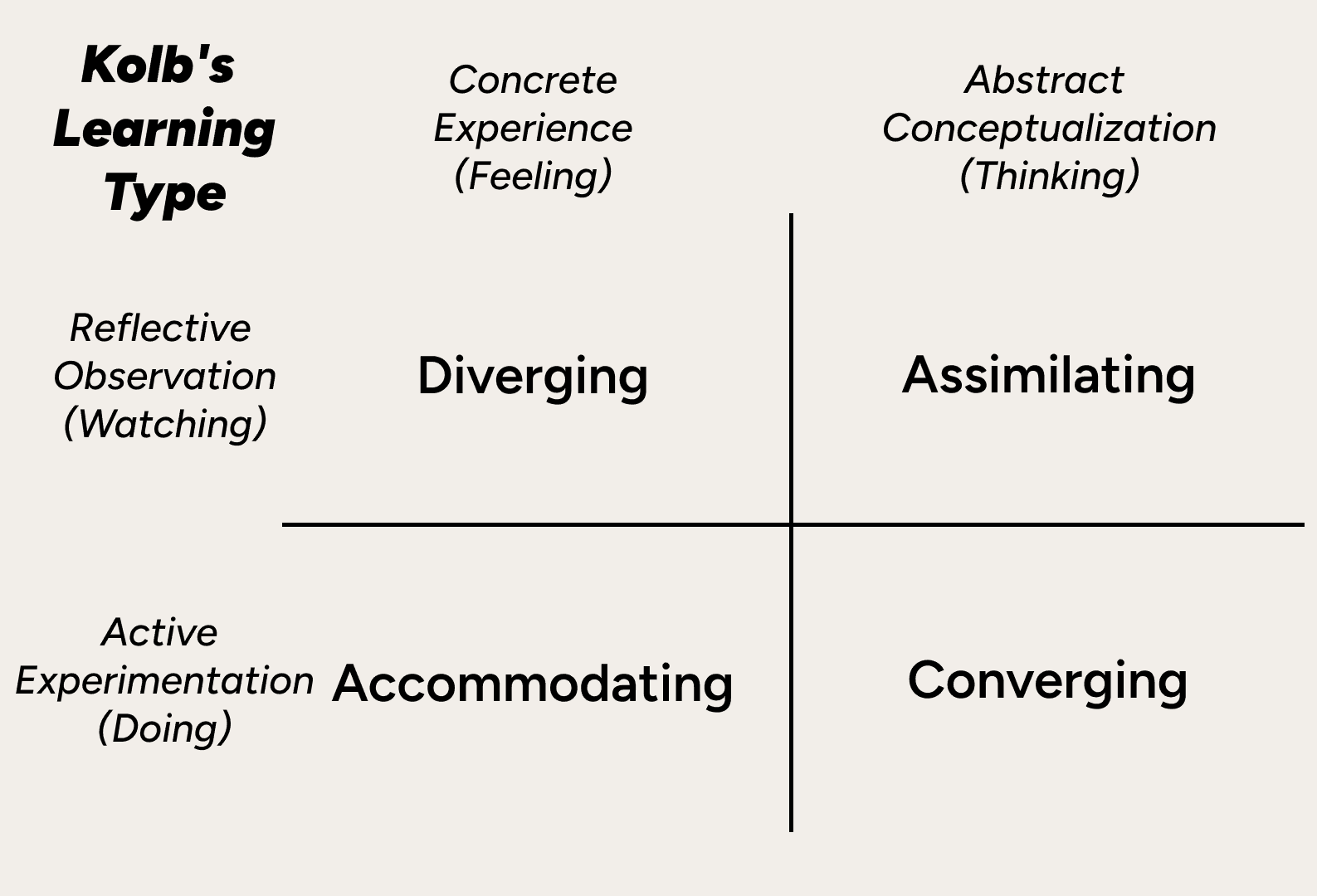
Kolb's Four Learning Styles: People learn differently based on how they approach tasks (doing vs. watching) and how they process experiences (thinking vs. feeling). These create four types: Diverging, Assimilating, Converging, and Accommodating.
Last week, we explored Kolb's Experiential Learning Cycle, the four-stage loop of Concrete Experience, Reflective Observation, Abstract Conceptualization, and Active Experimentation.
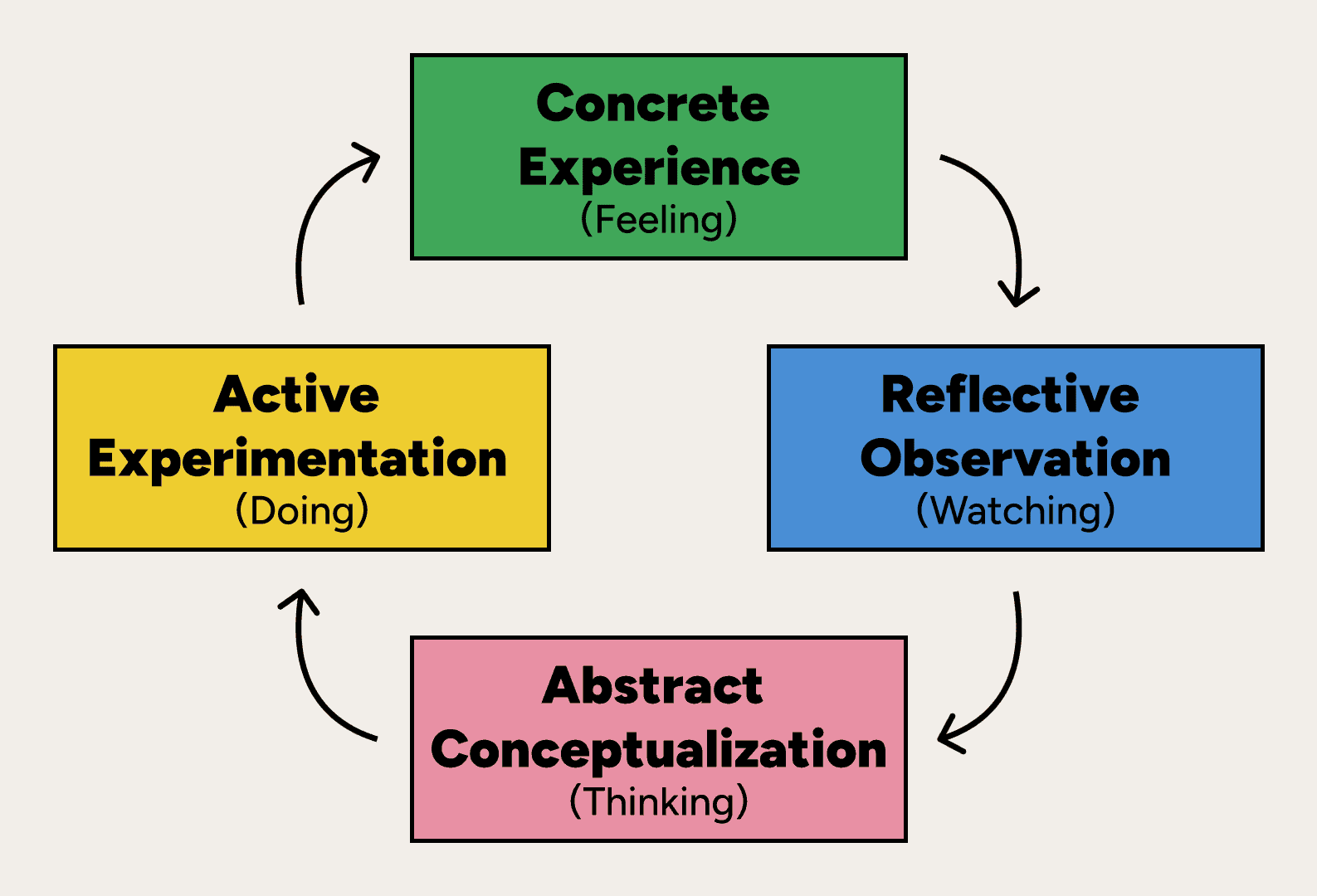
But Kolb's theory goes further. He also identified that people have different preferences within this cycle.
These preferences emerge from two dimensions.
- Processing: how you approach a task. Do you prefer doing (Active Experimentation) or watching (Reflective Observation)?
- Perception: how you respond. Do you lean toward thinking (Abstract Conceptualization) or feeling (Concrete Experience)?
These create four styles:
- Diverging (Feeling + Watching): Imaginative brainstormers who see multiple perspectives. The creative who generates ideas.
- Assimilating (Thinking + Watching): Logical planners who organize information into theories. The architect of coherent plans.
- Converging (Thinking + Doing): Practical problem-solvers who find uses for ideas. The engineer who makes things work.
- Accommodating (Feeling + Doing): Hands-on executors who rely on intuition. The builder who learns by trial and error.
No one fits neatly into just one style. Effective learning engages all four. This also explains why diverse teams outperform homogeneous ones.
Two related past inputs: Learning Style Myth and Bartle Taxonomy of Player Types.