The Zone of Proximal Development: Learning happens best in the gap between what you can do alone and what you can achieve with guidance. Too easy breeds boredom. Too hard creates frustration. The sweet spot is in between.
Paper: Generative artificial intelligence: the 'more knowledgeable other' in a social constructivist framework of medical education and Zone of Proximal Development
Like the Cognitive Load Theory we noted last week, the Zone of Proximal Development (ZPD) is another well-known theory in learning science. Hearing people in edtech mention ZPD always makes me happy because it shows they care about pedagogy.
Lev Vygotsky, a Soviet psychologist, introduced the Zone of Proximal Development to explain how learning actually works.
The core idea: there's a gap between what a learner can do independently and what they can achieve with help. That gap is where real learning happens.
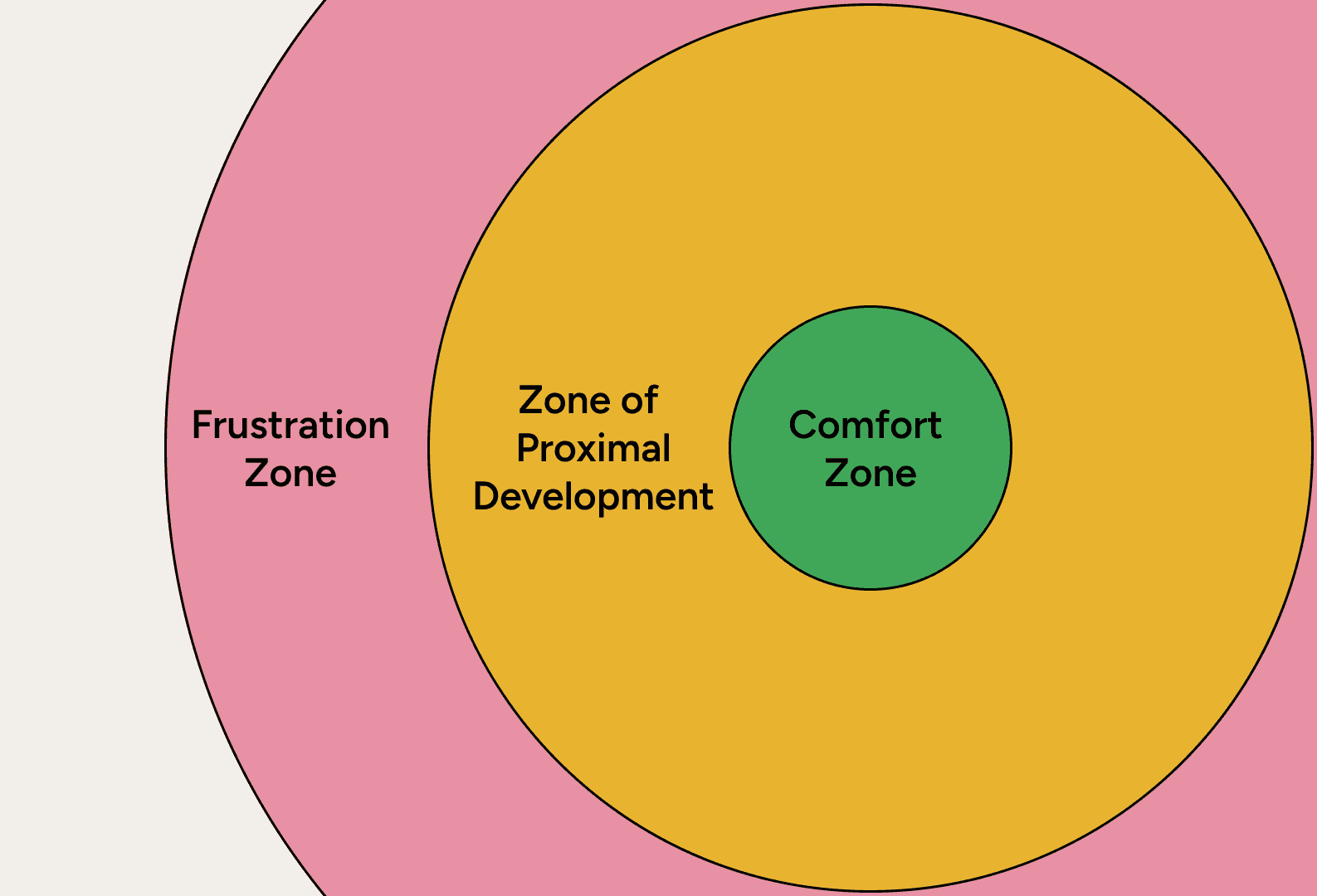
Think of it as three zones:
- The Comfort Zone contains tasks you can handle alone. These demonstrate mastery but don't promote growth because they're too easy.
- The Zone of Proximal Development is the sweet spot. These are tasks you can't do alone but can achieve with guidance and support. This is where skills are stretched and internalized.
- The Frustration Zone contains tasks that are too difficult even with help. Attempting to teach here leads to discouragement rather than growth.
The ZPD relies on what Vygotsky called the "More Knowledgeable Other" (MKO), someone who can bridge the gap. This is typically a teacher or mentor, but it can also be a peer or even technology (GenAI can be MKO too)
The key mechanism is scaffolding: temporary support structures that help learners accomplish what they couldn't alone. A teacher might model behaviors, provide hints, break complex tasks into smaller steps, or use visual aids.
As the learner gains competence, the scaffolding is gradually removed, just like physical scaffolding comes down when a building can stand on its own.
Vygotsky also saw learning as fundamentally social. Knowledge begins as something that happens between people and becomes internalized by the individual. The external conversation eventually becomes inner speech, allowing the learner to self-regulate and solve problems independently.